
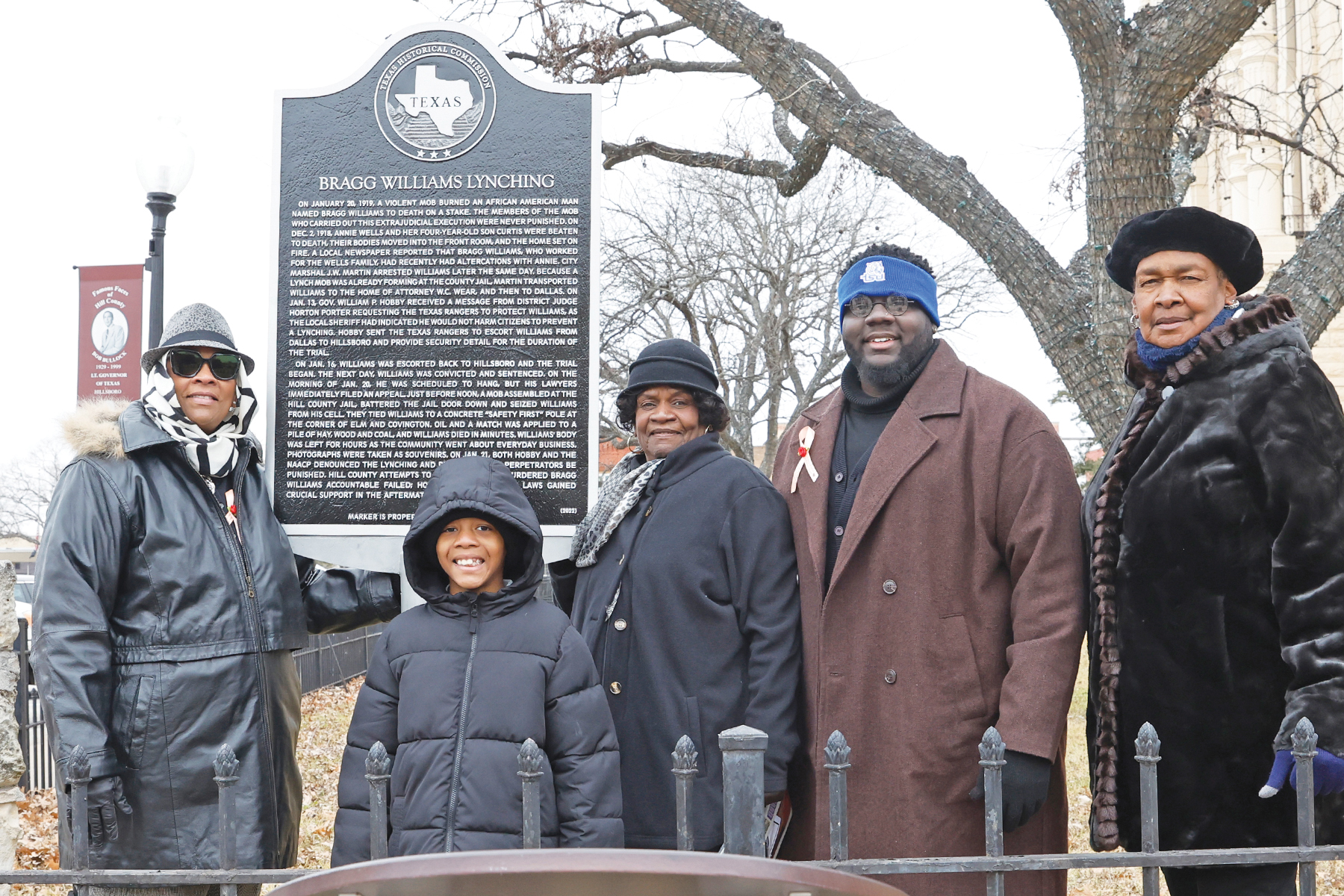
The Hill County Historical Commission hosted a Texas Historical Marker dedication marking the site of the 1919 Bragg Williams lynching Monday, January 20.
Members joined with county officials, Williams’ family members and the public on the southwest corner of the Hill County Courthouse lawn for the unveiling.
Williams’ nieces, Crady Johnson and Tonya Carmel, partnered with journalist E.R. Bills to file the marker application after they read his 2019 Fort Worth Weekly article about the lynching.
In the article, Bills described how Williams, who was reportedly intellectually disabled, was accused of murdering a mother and son in Itasca. Apparently unable to grasp the gravity of the accusations against him, it was reported at the time that Williams laughed in court after he was convicted.
While an appeal was pending, a mob took Williams from the jail and burned him on the courthouse lawn.
Bills wrote, “Guilty or innocent, mentally fit or unfit, what happened to Bragg Williams was a mockery of justice, an affront to human decency, and a vile monstrosity.”
Bills was recognized for his efforts by family members who came from the Fort Worth area and beyond.
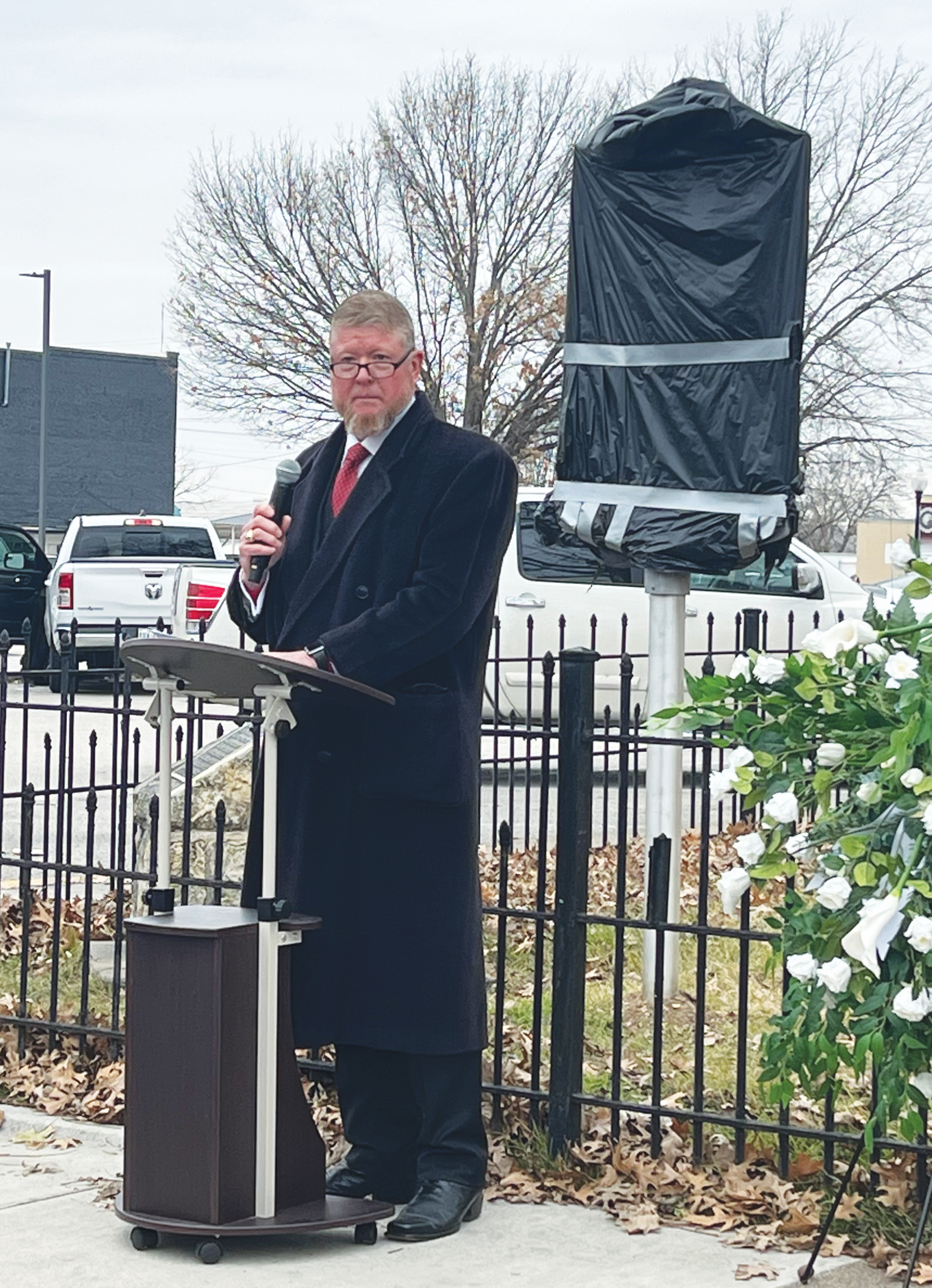
County Judge Justin Lewis addressed the crowd, saying that the historical marker serves as a reminder that history is not just a series of dates and events, but a reflection of who we were, who we are and who we strive to be.
“We dedicate this historical marker to two pivotal moments in the history of Hill County: the brutal lynching of Bragg Williams and the tragic murders of Annie Wells and her four-year-old son, Curtis,” said Lewis. “These events, though separated by short time and by the twist of history, are bound by the unrelenting presence of injustice, violence and the scars that they’ve left on the soul of this community.”
Lewis said that Williams became a casualty of a system that far too often allowed vengeance to take the place of justice.
“As we dedicate this monument, we commit ourselves to a future where justice is not just a word, but a living, breathing principle,” the judge said. “One that transcends race, one that offers equal protection for all, and one that fosters peace and understanding amongst all people.
“We vow not to let history be forgotten, not to let injustice fester and not to let hatred divide us.”
Dr. David L. Brown, a retired faculty member of East Texas A&M University and the great nephew of Williams, also delivered remarks.
Brown remembered his time with Williams’ mother, Emma, who lived to be over 100 years old. He said that his great-grandmother never spoke of the lynching with the younger children. “I wonder today how did she keep that within her? She didn’t let that tragedy define her life,” he said. “She didn’t preach hatred to us toward another group of individuals.”
Brown said that it was her faith that kept her mentally strong. “She believed that whatever happened in life, God always had the final word,” said Brown. “Consequently, she would not want family members to live with hatred of people who violated the civil rights of Bragg Williams. That’s not something she would endorse…she would want family members to pray for those whose hearts were filled with hatred and prejudice.”
The marker reads as follows:
BRAGG WILLIAMS
LYNCHING
On January 20, 1919, a violent mob burned an African American man named Bragg Williams to death on a stake. The members of the mob who carried out this extrajudicial execution were never punished. Dec. 2, 1918, Annie Wells and her four-year-old son Curtis were beaten to death, their bodies moved into the front room, and the home set on fire. A local newspaper reported that Bragg Williams, who worked for the Wells family, had recently had altercations with Annie. City Marshal J.W. Martin arrested Williams later the same day. Because a lynch mob was already forming at the county jail, Martin transported Williams to the home of attorney W.C. Wear, and then to Dallas. On Jan. 13, Gov. William P. Hobby received a message from District Judge Horton Porter requesting the Texas Rangers to protect Williams, as the local sheriff had indicated he would not harm citizens to prevent a lynching. Hobby sent the Texas Rangers to escort Williams from Dallas to Hillsboro and provide security detail for the duration of the trial.
On Jan. 16, Williams was escorted back to Hillsboro and the trial began. The next day, Williams was convicted and sentenced. On the morning of Jan. 20, he was scheduled to hang, but his lawyers immediately filed an appeal. Just before noon, a mob assembled at the Hill County jail, battered the jail door down and seized Williams from his cell. They tied Williams to a concrete “safety first” pole at the corner of Elm and Covington. Oil and a match was applied to a pile of hay, wood and coal, and Williams died in minutes.
Williams’ body was left for hours as the community went about everyday business.
Photographs were taken as souvenirs. On Jan. 21, both Hobby and the NAACP denounced the lynching and requested the perpetrators be punished. Hill County attempts to hold those who murdered Bragg Williams accountable failed; however, anti-lynching laws gained crucial support in the aftermath.
 The Lakelander