
The U.S. Army Corps of Engineers and Brazos River Authority hosted a public meeting in Hillsboro Thursday evening, August 14, to present the draft plan for a reallocation of water from Lake Whitney. A large crowd gathered to hear the presentation, provide feedback and express concerns about the plan.
The Corps and Brazos River Authority (BRA) have been working on the reallocation to address current and projected water demands throughout the Brazos River Basin.
The proposal will provide more water supply storage for municipal and industrial needs while reducing the amount designated for hydropower due to changing market conditions.
Many Lake Whitney residents and business owners were present and spoke out against the plan, but BRA officials said Friday that they believe much of the concern has come from a misunderstanding of what the plan actually proposes.
Overall, the Corps projects that the difference in monthly average lake level is modeled to be less than one foot under the reallocation proposal.
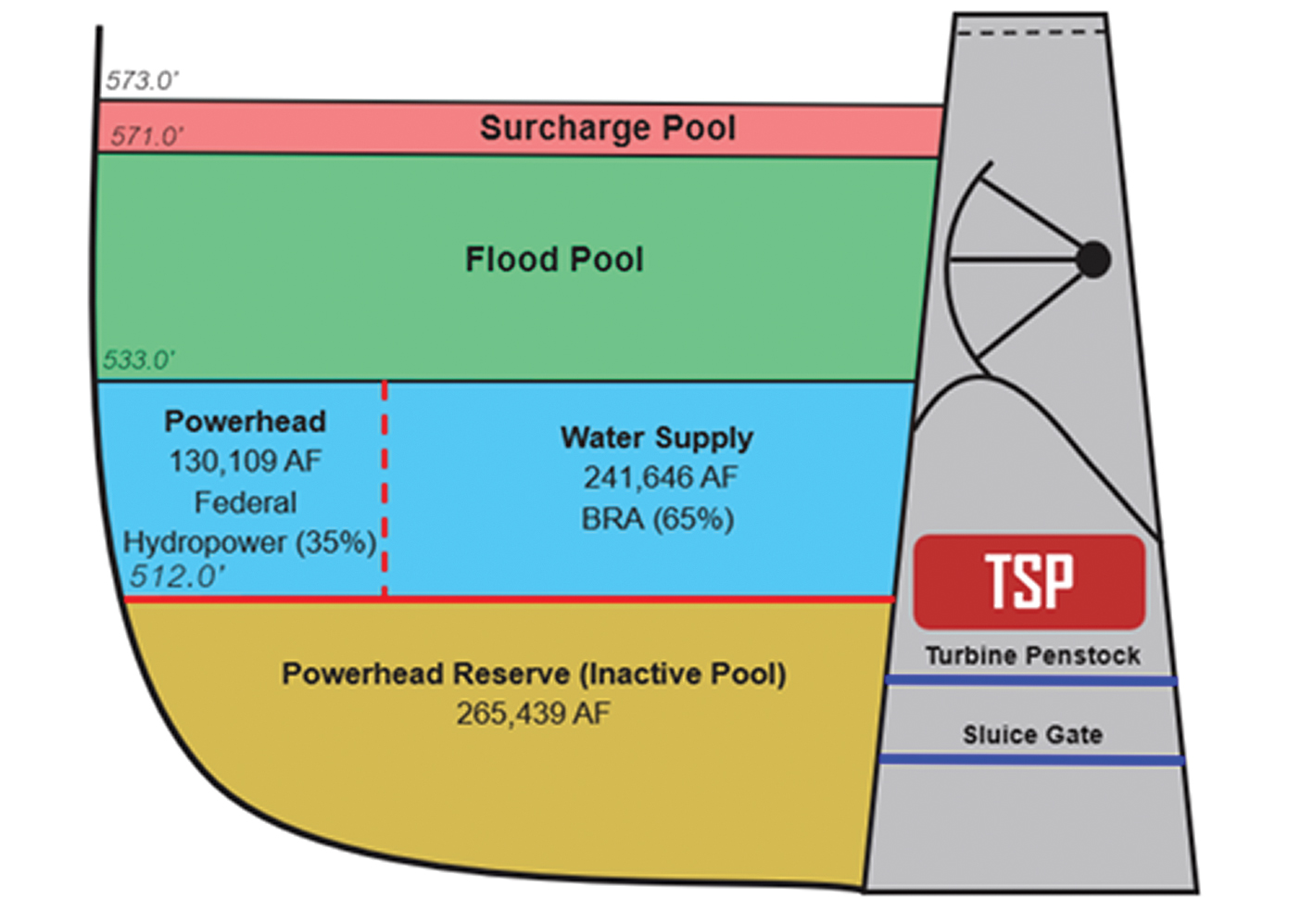
Lake Whitney’s current makeup includes the inactive pool, which is storage below 520 feet that serves the purposes of powerhead reserve and sedimentation; the conservation pool, which is the elevation between 520 feet and 533 feet that is regulated for hydropower generation and water supply; and the flood pool, which is the area in excess of 533 feet that can be used for flood control.
The tentatively selected plan would equally divide storage in the current conservation pool between water supply and hydropower uses. Currently, water supply is allocated 22% of the storage between 520 and 533 feet, and hydropower is allocated 78%. The reallocation would be accomplished by moving 72,817 acre-feet (ac-ft) of storage from power to water supply uses.
In addition, the plan calls for the reallocation of 111,537 ac-ft of storage from the inactive pool to water supply uses.
The top of the conservation pool will stay the same, at 533 feet, under the plan. The bottom of the conservation pool will drop by 8 feet from an elevation of 520 feet to 512 feet due to the reallocation of some of the water in the inactive pool.
The 8-foot drop in the bottom of the conservation pool is where the confusion has been for many people, according to BRA Water Services Manager Aaron Abel. “I think where people are getting tied up is thinking that the lake level will be at 512,” he said. “That is not the case.”
BRA and Corps representatives presented information showing that the lake has actually held more water in the past 10 years than it has historically due to changes in hydropower processes.
BRA Senior Water Resources Planner Dr. Peyton Lisenby said that hydropower at the lake operated in a “peaking” capacity — generating power to meet demand during peak hours — until 2015, when “ready reserve” hydropower became the primary operation. Ready reserve operations require much less generation and involve selling the potential to supply power to the market instead of actual power itself.
Without as much generation, the lake level has been higher. The average lake level now is 532.2 feet, but from the time the current lake level was established in 1973 through 2015, it averaged 528.8 feet. Under the reallocation proposal, the average lake level is projected to be 531.3 feet.
Abel said that under the proposal, lake levels will be higher than they were before the hydropower changes of 2015, and less water will be released than when the lake operated in peaking capacity.
BRA Chief Operations Officer Brad Brunett, who introduced himself at Thursday’s meeting as a 50-year Whitney resident, attempted to address concerns from the crowd after the presentation concluded. “I will tell you, as a Whitney resident, and as someone who has been doing this job for 30 years, what we’re talking about doing here is not going to affect the economy of the lake,” he said.
As the crowd continued to disagree, Brunett said, “The thing that I wanted everybody to take away from here tonight, and I can’t make you believe it, but going forward with this plan, lake levels in Lake Whitney are going to be better than they were from 1973 to 2015.”
Another concern raised at the meeting was that the water was going to data centers, such as the new data center in Laguna Park. BRA officials stressed last week that the request is in no way tied to the data center, and Brunett said at the meeting that he noticed the data center in Laguna Park when everyone else did. “There is zero connection with that data center,” he said.
When questioned about other data centers in the metroplex, Brunett said that there was also no connection between this plan and those data centers.
BRA and the Corps have been working on the study since 2023, and BRA has been asking the Corps to consider reallocating water that was not being used for hydropower for several years.
The study lays out the expected water demands in Region G, which includes Hill County and is one of 16 regional water planning areas created by the Texas Legislature in 1997. Total water demand in the region is projected to rise nearly 42% over the coming decades, with the largest increases expected in public water supply use, followed by manufacturing.
The study also shows that Texas has gained more residents than any other state since 2000, and rapid population and industrial growth continues, driving rising water demand. In the Brazos River Basin, one of the fastest-growing regions, all reliable surface water is fully allocated, and existing supplies have declined over time due to sedimentation and depletion.
BRA found that the reallocation plan was the most regionally beneficial, least environmentally impactful and most cost-effective water management strategy being undertaken in the basin. BRA said that the plan will provide substantial water supply benefits with little to no impact to other authorized purposes of the lake.
The public comment period ended August 20, after which comments will be reviewed and incorporated into the report with any responses. The tentatively selected plan will then move up through the Corps of Engineers’ chain of command, and BRA officials are hoping for final approval next spring.
The approval would allow BRA to contract with the Corps for the additional water in the lake, and the authority to use that water will need to be approved at the state level.
Study documents are available for the public to view online at http://www.swf.usace.army.mil/Missions/Civil-Works/Whitney-Lake-Reallocation-Study.
 The Lakelander