
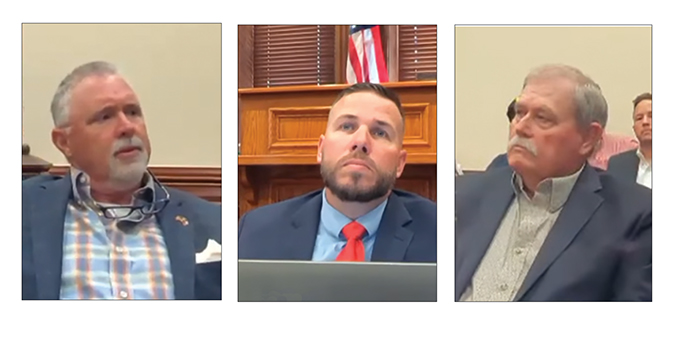
Calling it a “line in the sand” moment for Hill County, the commissioners court approved what appears to be the first countywide moratorium on new data centers in Texas after County Judge Shane Brassell cast the tie-breaking vote Tuesday, May 12. The proposal, introduced by Precinct 1 Commissioner Jim Holcomb, narrowly passed despite warnings from County Attorney David Holmes that the action exceeded the court’s authority and is likely to result in litigation.
Holcomb and Precinct 2 Commissioner Larry Crumpton voted in favor of the moratorium, while Precinct 3 Commissioner Scotty Hawkins and Precinct 4 Commissioner Martin Lake voted no. Hawkins told the court that while he also wants to stop data center development, he does not believe the moratorium is legal and wants to go about it another way.
The vote followed nearly four hours of public comments as residents packed the county courtroom and lined the hallway outside, urging commissioners to take action against large-scale data center development in rural Hill County.
Speakers raised concerns about long-term water availability, environmental impacts and fire risks in areas served only by volunteer fire departments.
Others said that the rapid spread of industrial-scale projects like solar farms is already transforming the county’s rural character. One resident told commissioners that solar development had already reached one property line and a data center now threatens another.
As the court began deliberating, Brassell said that he struggled with balancing private property rights against concerns about the county’s future, while also pushing back against what he described as a misconception that he supported bringing data centers to Hill County.
“I do not want data centers in Hill County,” Brassell said. “I figured we need to put that on the record.” He said that his message to any data center developer that has contacted him is “we don’t want you here.”
Brassell said that the extent of the proposed development in Hill County only became clear after the moratorium was placed on the agenda. When the agenda went public, it triggered a wave of calls from companies that opposed the proposal.
Brassell said that he discussed the issue with state legislators and their concern is private property rights — and the fact that both Governor Greg Abbott and President Donald Trump are pushing for data center construction.
One large data center is already under construction in the Hubbard area, as Nexus plans to build a center on a 2,000-acre site. The moratorium — if it holds up — will not affect any data centers already under construction.
The order places a temporary halt on new large-scale battery storage facilities, data centers over 1,000 square feet, power generation projects and related infrastructure in unincorporated areas of Hill County while officials study potential impacts on roads, drainage systems, groundwater resources and emergency response capabilities.
The document passed by the court says that the moratorium will remain in effect for up to 12 months unless commissioners adopt new infrastructure and public safety standards sooner. Existing projects, agricultural operations and developments inside city limits will be exempt.
Holcomb said that it is imperative that the county “tap the breaks” and allow studies before it is overrun by data center developers. “The data center folks have found a sweet spot in a state that has limited regulations, limited enforcement and limited codes, and they are coming faster than we can keep up with them,” he said. “This is in no way, shape or form a push from this court to impair anyone’s rights to do with their own property what they want to do with it,” he said. “This is a public health and public safety matter that this court needs to take on.”
After Commissioner Hawkins questioned the legality of the proposed moratorium, County Attorney Holmes said that he does not believe the county has the legal authority to enact it.
Holmes said that he previously told Brassell that he believes counties lack the authority to enact such restrictions, citing a recent Texas attorney general opinion involving solar farms that he said was “very analogous” to the situation in Hill County.
He also referenced a recent letter from State Senator Paul Bettencourt regarding disputes over data center regulations in Hood County, adding that while state law grants limited moratorium authority to municipalities, that does not apply to counties.
Holmes noted that the proposed Hill County moratorium would last up to 12 months, and even cities that have more legal authority are only allowed to enact up to two three-month moratoriums.
“If you vote to enact this, I believe we will quickly be in litigation, perhaps with the attorney general’s office, and certainly with a few of the developers,” Holmes said. “That’s why I say you’re damned if you do and damned if you don’t.”
Both Brassell and Holcomb called the issue a “line in the sand” moment. “I promise you there are probably people from Austin watching this,” Brassell said. “This will be a shot across the bow in reference to the counties saying either you regulate them or give the counties some ability to regulate.”
Brassell noted that some rural counties may have a lot of land, a small population and welcome data centers, but others may want more control. “Let Hill County do what it wants,” he said.
As discussions continued, commissioners agreed that additional regulation will be necessary as development pressures increase, noting that the county has limited authority over private land use and industrial projects.
However, they said one tool available to them would be the hiring of a county fire marshal to help inspect and monitor future development. Brassell said that the position had already been under consideration but that the moratorium debate could accelerate the timeline.
Commissioners expressed support for moving forward with establishing the fire marshal position as part of the county’s broader effort to strengthen oversight of industrial projects.
Brassell also emphasized the importance of taking the issue to Austin and showing up to public meetings held by state agencies, like the Texas Commission on Environmental Quality, when permits are considered.

